
Essay + ledger · June 1–30, 2026
The kindness ledger: tracking spending worth keeping
A month of writing down what money gave back—not to justify every pleasure, but to remember what “enough” can include.
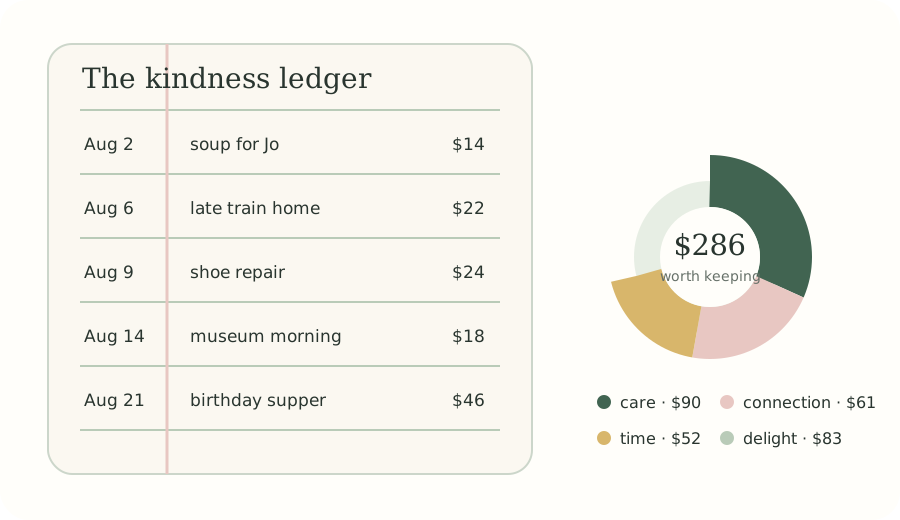
In June 2026, I logged $286 of spending I was genuinely glad happened: $90 for care, $61 for connection, $52 for saved time, and $83 for delight. The kindness ledger did not replace a budget. It corrected the budget’s blind spot by preserving value, context, and memory beside the amount.
A ledger usually remembers only the leaving
Ordinary expense records are good at one half of a transaction. They preserve the date, merchant, category, and amount that left. They rarely preserve that the $14 soup on June 2 fed a friend who had no energy to cook, or that the $22 late train on June 6 bought an extra hour with my sister and a safer trip home.
This is not a complaint about bookkeeping. A category does useful work precisely because it compresses. But after years of seeing discretionary totals only as numbers to reduce, I wanted a small counter-record: which purchases would I actively choose to keep in the month if I could edit it afterward?
The rules were deliberately light
From June 1 through June 30, I kept my usual budget. I did not give myself extra “kindness money.” When a purchase felt genuinely worthwhile a day later, I wrote its date, amount, and one sentence about what it gave back. I used four loose labels: care, connection, time, and delight.
There was no points system. A practical expense did not qualify automatically, and an unnecessary one was not disqualified. Rent never entered the ledger; I was glad to be housed, but the payment felt like infrastructure rather than a specific choice. An $18 museum morning on June 14 did enter because I was still thinking about two paintings at dinner.
Care: $90
Care included $14 of soup and bread for Jo on June 2, my $24 shoe repair on June 9, a $16 pharmacy delivery while ill on June 17, and $36 toward a cleaner for my father’s kitchen on June 25. They were not all generous acts. Repairing my own shoes counted because future me needs dry feet too.
The pharmacy delivery deserves its fee. In another mood I might call $6 of the total avoidable. That afternoon, it bought rest and kept a feverish person off a bus. The ledger made a useful distinction between convenience purchased automatically and convenience purchased at the exact moment it protects something.
Connection: $61
Connection held a $15 train ticket to see my sister on June 6, $46 for a birthday supper shared with two old friends on June 21, and nothing else. The short list surprised me. I had bought several coffees during the month, but most were solo drinks while working. Pleasant is not the same as connection, and the ledger did not need to recruit every treat.
The supper ran $11 above its dining envelope. I moved that amount from an unused clothing category on June 22. A zero-based plan is allowed to change when priorities become clearer; zero means every available dollar has a job, not that the first draft is sacred.
Time: $52
Time included the $22 late train, $18 for two prepared lunches during a deadline week, and $12 for a cab shared after a community meeting ended late. Each purchase was easy to criticize in isolation. Together, they revealed the conditions under which convenience was useful: fatigue, safety, and a specific workload—not boredom.
The category also showed where money was not the answer. On June 12 I nearly ordered dinner because cooking felt impossible. A frozen portion of soup took eight minutes and solved the same problem. The ledger was not an instruction to buy relief. It helped me notice which form of relief fit.
Delight: $83
Delight was the broadest and most suspicious-sounding label, which is why I kept it. It included the museum ticket, $27 for a used hardback I had borrowed twice, $8 for strawberries at their brief fragrant best, $12 for a cinema matinee, and $18 for flowers brought to a shared summer dinner.
None was optimized. The book could have remained borrowed, the flowers lasted five days, and the film will eventually stream. Yet each had a clean edge: I knew what it was for, enjoyed it fully, and did not need a neighboring purchase to complete it. Delight turned out to be less expensive than restless shopping because it was specific.
| Kind | Total | Entries | What earned a place |
|---|---|---|---|
| Care | $90 | 4 | Health, maintenance, practical help |
| Connection | $61 | 2 | Time meaningfully shared |
| Time | $52 | 4 | Relief during fatigue, risk, or real pressure |
| Delight | $83 | 5 | Specific, complete enjoyment |
| Total | $286 | 15 | 9.2% of June take-home pay |
What did not make the ledger
I spent $94 on other discretionary purchases in June: coffees, a phone case, two unremarkable lunches, streaming, and a craft supply I have not opened. None was disastrous. The phone case was useful. They simply did not carry enough meaning a day later to write down. That $94 offered gentler evidence than a shame list: here was spending I could reduce without making life smaller.
I also refused to log purchases in real time. Immediate judgment would have turned the exercise into permission seeking. The next-day delay let novelty settle. It resembles the waiting note in Mara’s soft no-spend diary, though this ledger looks backward at value rather than forward at desire.
The danger of making joy perform
A kindness ledger can become another demanding metric. If every pastry must demonstrate impact, pleasure has acquired paperwork. I stopped after 30 days because the exercise had answered its question.
It depends on money beyond fixed needs. A low total may simply mean the month left no room. Spending is not all kindness: the best care I received in June—a neighbor carrying a heavy parcel upstairs—cost nothing.
What stayed in my budget
On July 1, I made three modest changes. I raised “people and places” from $60 to $80, kept a $25 convenience buffer, and lowered unassigned shopping by $30. I added no kindness category. The ordinary categories still tell me whether the plan fits; the month’s notes tell me what I want the plan to protect.
If you need an app for the arithmetic, our eight-question selection guide starts with how you already make decisions. If you prefer a tool beside the tool, our Goodbudget versus notebook test found that a seven-minute paper review held context better than a dashboard.
The kindness ledger left me with one durable question: when I read this purchase next month, will the number recall only money leaving, or will I remember what arrived?
Kindness ledger FAQ
What is a kindness ledger?
It is a short record of spending you are glad happened, noting what it gave back in care, connection, time, or delight. It sits beside a budget rather than replacing one.
Is worthwhile spending the same as essential spending?
No. Some essential bills feel neutral, while a nonessential museum ticket or meal with a friend can be deeply worthwhile. The ledger records experienced value, not a needs hierarchy.
Should every purchase prove its value?
No. The ledger is a temporary attention exercise, not a requirement to justify every coffee or quantify joy. I used it for 30 days and then stopped.
Iris Wren is ThriftWren’s contributing fact-checker. For this essay, she audited her own June 1–30, 2026 ledger and bank statement; names are used with permission.